

Application Case of Bird Condition Monitoring System for Yancheng Airport
Customer Background
Yancheng Nanyang International Airport is a 4C-level joint military-civilian airport. Located in the coastal area, it is affected by high humidity, salt spray corrosion and monsoon climate all year round. In recent years, with the ecological restoration of surrounding wetlands, the bird density has increased significantly, and the risk of bird strike has continued to rise.
Challenges
• High bird strike risk: Flocks of pigeons and herons frequently intrude into the runway. Traditional bird repellent equipment cannot locate the trajectory of bird flocks in real time, resulting in limited repellent effect.
• Poor environmental adaptability: There are many rainy and foggy weathers with severe salt spray corrosion, which greatly reduces the effectiveness of optical monitoring equipment.
• High operational pressure: In 2024, the passenger throughput exceeded 3 million, and the growth of flight volume has increased the pressure on bird strike control.
Solutions
Yancheng Nanyang Airport has built an all-weather, all-airspace low-altitude bird condition monitoring and intelligent bird repellent system, with "radar detection + photoelectric identification + intelligent linkage" as the core:
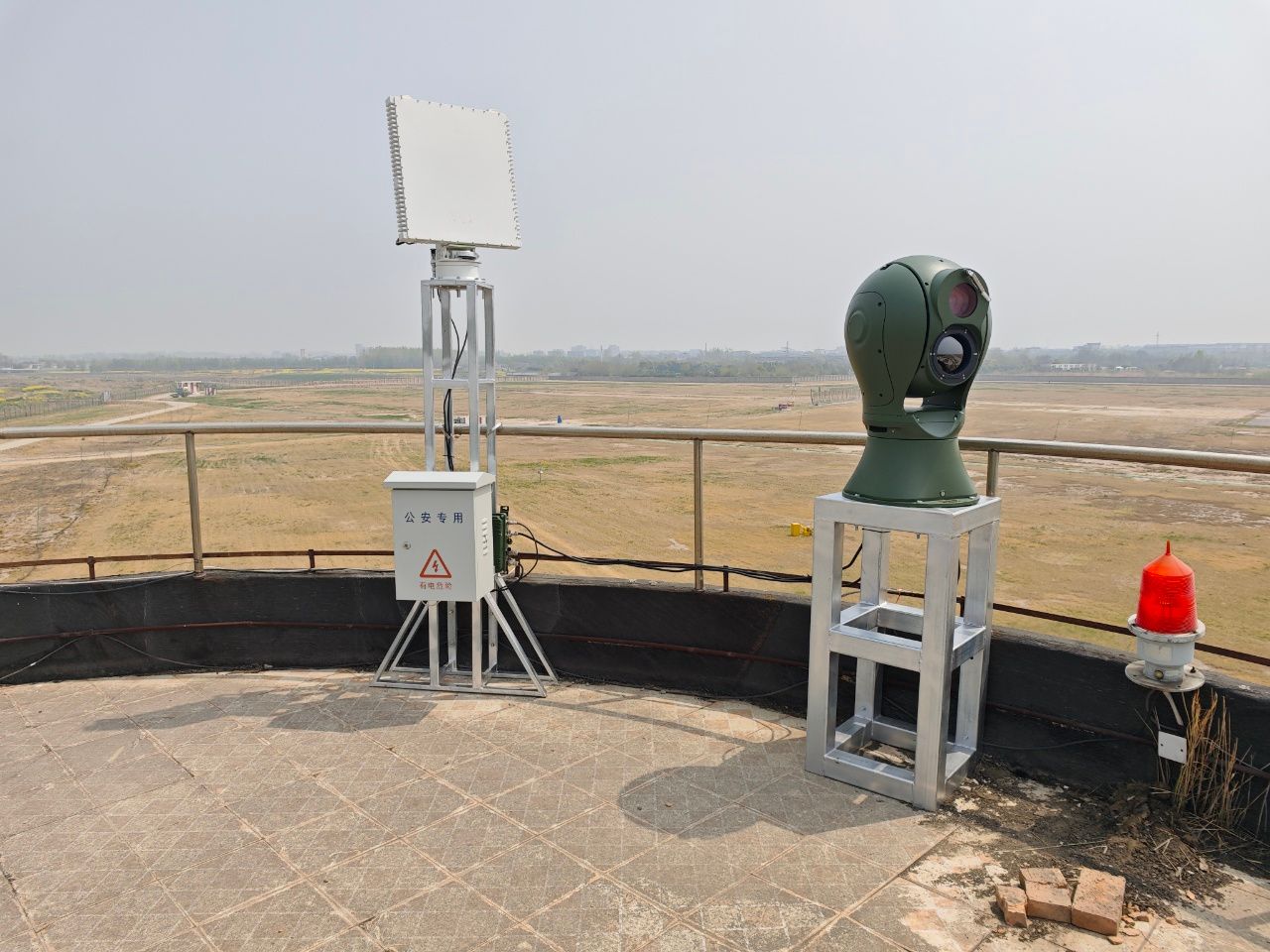
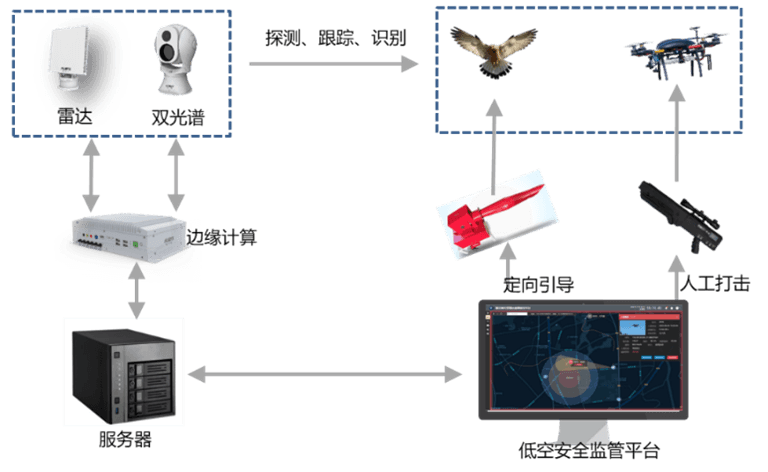 • RPA U02 low-altitude surveillance radar: Adopting X-band phased array system, it conducts uninterrupted scanning within a radius of 5km, accurately detects birds with a wingspan of more than 1 meter, with a blind area of ≤ 50m, and is not affected by rain, fog and night.
• RVD G02 dual-spectrum camera: It automatically locks targets under the guidance of radar, with visible light detection of ≥5km and thermal imaging detection of ≥2km, supporting forensics day and night.
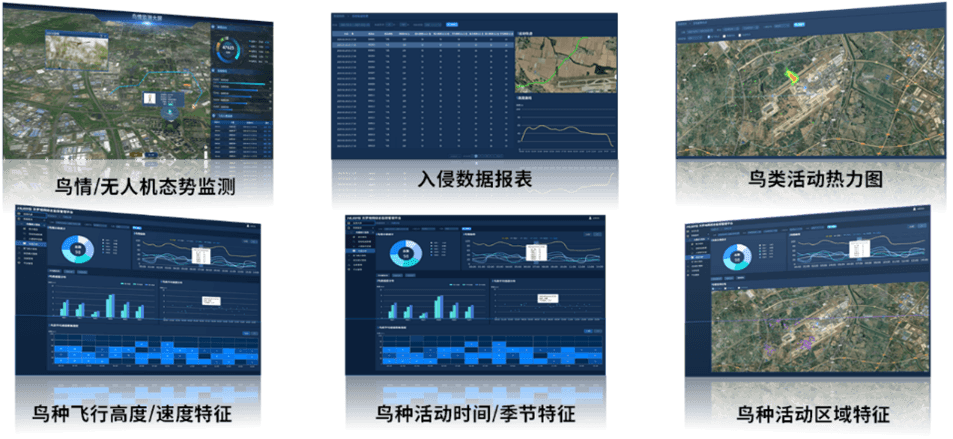
• RSP-AF management and control platform: It integrates radar and photoelectric data, automatically generates bird condition heat maps and statistical reports, and links with sound and light bird repellent equipment to realize the closed loop of "detection-identification-repellent-evaluation".
Implementation and Deployment
The project was launched in 2025. The low-altitude surveillance radar was deployed in the central area of the airport, and erected on the same pole as the dual-spectrum camera to ensure that the radar covers the whole site and the photoelectric system can guide quickly. All equipment adopts high anti-corrosion design to adapt to the coastal salt spray environment.
• RPA U02 low-altitude surveillance radar: Adopting X-band phased array system, it conducts uninterrupted scanning within a radius of 5km, accurately detects birds with a wingspan of more than 1 meter, with a blind area of ≤ 50m, and is not affected by rain, fog and night.
• RVD G02 dual-spectrum camera: It automatically locks targets under the guidance of radar, with visible light detection of ≥5km and thermal imaging detection of ≥2km, supporting forensics day and night.
• RSP-AF management and control platform: It integrates radar and photoelectric data, automatically generates bird condition heat maps and statistical reports, and links with sound and light bird repellent equipment to realize the closed loop of "detection-identification-repellent-evaluation".
Implementation and Deployment
The project was launched in 2025. The low-altitude surveillance radar was deployed in the central area of the airport, and erected on the same pole as the dual-spectrum camera to ensure that the radar covers the whole site and the photoelectric system can guide quickly. All equipment adopts high anti-corrosion design to adapt to the coastal salt spray environment.
 Application Effects
• All-weather accurate monitoring: The radar scans continuously 24 hours a day, having detected more than 100,000 batches of bird activities cumulatively, with the farthest detection distance of 4.8km and an identification accuracy of over 90%.
• Intelligent linked bird repellent: The platform automatically triggers the bird repellent equipment, with an average response time of less than 5 seconds, and the efficiency is increased by 80%. In the spring of 2025, more than 300 flocks of birds were repelled, and there were zero bird strike incidents.
• Data-driven decision-making: It automatically generates daily, weekly and monthly bird distribution maps to guide the optimization of bird repellent periods and layout.
• Improved operational safety: The system is linked with the control tower, and automatically alarms when the core area is intruded. In 2025, bird strike incidents decreased by 80% year-on-year, and the flight on-time rate increased by 1.2 percentage points.
Application Effects
• All-weather accurate monitoring: The radar scans continuously 24 hours a day, having detected more than 100,000 batches of bird activities cumulatively, with the farthest detection distance of 4.8km and an identification accuracy of over 90%.
• Intelligent linked bird repellent: The platform automatically triggers the bird repellent equipment, with an average response time of less than 5 seconds, and the efficiency is increased by 80%. In the spring of 2025, more than 300 flocks of birds were repelled, and there were zero bird strike incidents.
• Data-driven decision-making: It automatically generates daily, weekly and monthly bird distribution maps to guide the optimization of bird repellent periods and layout.
• Improved operational safety: The system is linked with the control tower, and automatically alarms when the core area is intruded. In 2025, bird strike incidents decreased by 80% year-on-year, and the flight on-time rate increased by 1.2 percentage points.
 Customer Comments
"HURYS system has helped us transform from 'passive bird repellent' to 'active early warning', with visual bird condition data and intelligent bird repellent, which has truly built an invisible air safety barrier for the airport." —— Person in charge of the Flight Area Management Department of Yancheng Nanyang Airport.
<u>(Note: This case is reasonably deduced based on actual equipment indicators and airport requirements, and the specific data shall be subject to actual operation)</u>
Customer Comments
"HURYS system has helped us transform from 'passive bird repellent' to 'active early warning', with visual bird condition data and intelligent bird repellent, which has truly built an invisible air safety barrier for the airport." —— Person in charge of the Flight Area Management Department of Yancheng Nanyang Airport.
<u>(Note: This case is reasonably deduced based on actual equipment indicators and airport requirements, and the specific data shall be subject to actual operation)</u>