Intersection Radar Stitching Technology
Intersection Radar Stitching Technology
1) Technical Principle
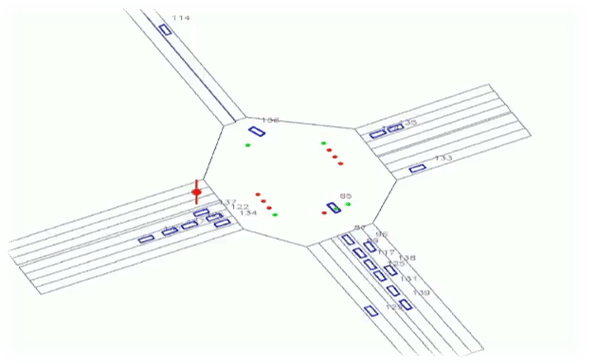
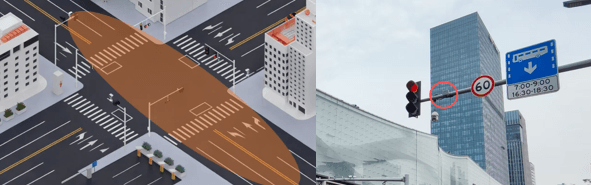
Four millimeter-wave radars are deployed on traffic signal poles to achieve full-coverage, blind-spot-free intersection sensing. An edge computing unit performs multi-radar spatial-temporal synchronization, coordinate alignment, and trajectory fusion stitching to generate continuous, complete vehicle trajectories. The fused full-coverage perception data is uploaded in real time via high-reliability communication, accurately reconstructing the full-element traffic situation of the intersection. This provides solid technical support for digital twin intersections, intelligent signal control, and V2X applications.
2) Key Features
-
Full-coverage blind-spot-free sensing – Achieves full-area, all-time, full-element coverage, eliminating blind spots of single radar.
-
High-precision trajectory reconstruction – Multi-radar spatial-temporal synchronization, coordinate registration, and trajectory fusion stitching generate continuous trajectories from entry to exit, with positioning accuracy at the decimeter level.
-
Low-latency edge computing – Data collection, fusion, and stitching completed at the edge, with millisecond-level response.
-
Full-scenario adaptability – Millimeter-wave radar unaffected by lighting, rain, snow, fog, or other adverse weather, ensuring 24/7 stable sensing and adapting to complex traffic scenarios.